LayerZero V2 Part 3: The DVN Security Model
This is Part 3 of a series on LayerZero V2. Part 1 covers the basics, Part 2 covers the message lifecycle.
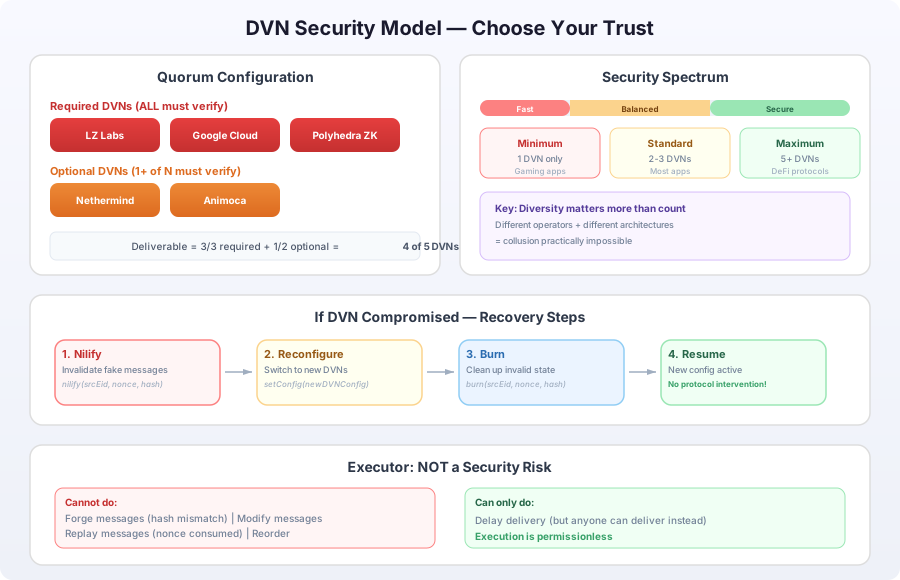
The DVN security model is the most important part of LayerZero V2. It determines who you trust and how much.
How DVN Configuration Works
Every app sets its own DVN configuration per pathway (source chain → destination chain):
My App's Security Config:
  Required DVNs:  [LayerZero Labs, Google Cloud]    ← BOTH must verify
  Optional DVNs:  [Polyhedra ZK, Nethermind]        ← At least 1 must verify
  Threshold:      1
A message is deliverable when:
- ALL required DVNs have verified, AND
- At least [threshold] optional DVNs have verified
Configuration Examples
Conservative (DeFi protocol):
Required: [LayerZero Labs, Google Cloud, Polyhedra ZK]
Optional: [Nethermind, Animoca]
Threshold: 2
All 3 required + 2 of 2 optional = 5 DVNs must agree. Very secure, slower.
Fast (gaming app):
Required: [LayerZero Labs]
Optional: [Google Cloud]
Threshold: 1
1 required + 1 optional = 2 DVNs. Fast, good enough for low-value transfers.
Minimum:
Required: [LayerZero Labs]
Optional: none
Single DVN. Fastest, but you’re trusting one entity completely.
Why This Matters
In V1, every app shared the same oracle and relayer. If they were compromised, every app was affected.
In V2, each app controls its own security:
- A gaming app can use 1 fast DVN
- A DeFi protocol managing billions can use 5 diverse DVNs
- The security budget matches the risk
The Attack: DVN Collusion
The main risk in LayerZero V2: if all your required DVNs plus enough optional DVNs collude (work together to lie), they can forge fake messages.
What a forged message can do:
- Mint tokens on the destination that were never locked on the source
- Trigger arbitrary actions in your
_lzReceive()handler - Drain funds if your contract trusts the message content
How to Prevent Collusion
Use DVNs with different architectures, operators, and incentives:
| DVN | Type | Why It’s Different |
|---|---|---|
| LayerZero Labs | Centralized infra | Protocol-native, fastest |
| Google Cloud | Enterprise infra | Different operator, different incentives |
| Polyhedra | ZK cryptographic proofs | Math-based verification, not trust-based |
| Nethermind | Ethereum client team | Different codebase, different infrastructure |
For LayerZero Labs, Google, and Polyhedra to collude, a crypto startup, Google, and a zero-knowledge proof system would all need to cooperate in fraud. The diversity makes collusion impractical.
Trust Assumptions
| Assumption | If Violated | Mitigation |
|---|---|---|
| Required DVNs don’t collude | Forged messages accepted | Use diverse DVNs (different operators, architectures) |
| DVNs are available | Messages delayed | Permissionless execution — anyone can deliver |
| Executor delivers timely | Delayed execution | Any entity can call lzReceive directly |
| OApp owner configures correctly | Weak security stack | Use enforceOptions, multisig ownership |
The Executor Is NOT a Security Risk
A common misconception: “the Executor can manipulate messages.” It can’t. Here’s why:
The Executor can only call lzReceive() with a message that has already been verified by DVNs. The Endpoint checks the payloadHash — if the Executor tries to deliver a modified message, the hash won’t match, and the transaction reverts.
What the Executor cannot do:
- Forge a message (payloadHash won’t match)
- Modify a message (payloadHash won’t match)
- Replay a message (nonce already consumed)
- Reorder messages (nonce verification prevents it)
What the Executor can do:
- Delay delivery (but anyone else can deliver instead)
That’s it. The Executor’s only power is timing, and even that is mitigated by permissionless execution.
Recovery From Compromise
If a DVN is compromised, you can recover without any help from LayerZero:
Step 1: Nilify
endpoint.nilify(srcEid, sender, nonce, payloadHash);Invalidate any fake messages the compromised DVN verified. They can no longer be executed.
Step 2: Reconfigure
Switch to different, trusted DVNs:
endpoint.setConfig(oappAddress, libAddress, newDVNConfig);Step 3: Burn
endpoint.burn(srcEid, sender, nonce, payloadHash);Clean up the invalidated state.
Step 4: Resume
New messages use the updated DVN configuration. No protocol-level intervention needed.
Immutability: What Can and Can’t Change
Truly Immutable (nobody can change):
- EndpointV2 contract code
- Deployed MessageLib code
- MessageLib registry (append-only — new libs can be added, old ones can’t be removed)
Changeable by OApp Owner:
- Which MessageLib to use
- DVN configuration
- Executor configuration
Changeable by LayerZero Governance:
- Default configuration (but explicitly configured apps are unaffected)
- Registering new MessageLibs (but can’t modify existing ones)
The guarantee: If you explicitly set your send library, receive library, and DVN config, those settings can NEVER be changed by anyone except you (the OApp owner).
Competitive Comparison
| LayerZero V2 | Wormhole | Axelar | CCIP | |
|---|---|---|---|---|
| Security model | App-configurable DVN set | 13-of-19 fixed Guardians | PoS validator set | DON + Risk Mgmt |
| Endpoint | Immutable | Upgradeable | Upgradeable | Upgradeable |
| If compromised | App owner recovers independently | Protocol must respond | Protocol must respond | Protocol must respond |
| Security owner | Application developer | Wormhole governance | Axelar network | Chainlink |
LayerZero’s differentiator: application-owned security with immutable infrastructure. The tradeoff: security responsibility shifts to the application developer.
Next
- Part 4: OFT Token Bridging — Lock-and-mint, shared decimals, and fee quoting